
Storefront connection
WooCommerce.
Your storefront, with operations behind it.
Connect WooCommerce orders, stock and dispatch while keeping your existing storefront.
Responsibilities
Agree where each record belongs.
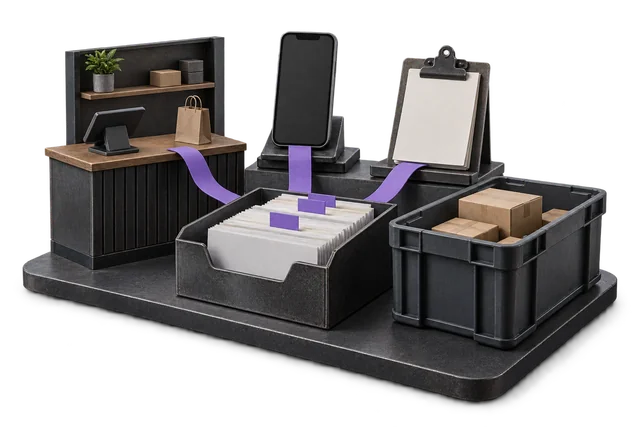
Confirm which platform owns product records, stock availability, cancellations and refunds. Storefront apps are not automatically replaced.
What flows where
Scope the records in each direction.
These are proposed flows for scoping, not a promise that every object or event is already supported.
| Record | From → to | Trigger | Scope note |
|---|---|---|---|
| Orders the moment they are placed (REST webhook) | WooCommerce → OpsUI | Agreed during scoping | Proposed flow. Account-level support must be confirmed. |
| Products, variants, attributes, and categories | WooCommerce → OpsUI | Agreed during scoping | Proposed flow. Account-level support must be confirmed. |
| Inventory adjustments from WooCommerce-side edits | WooCommerce → OpsUI | Agreed during scoping | Proposed flow. Account-level support must be confirmed. |
| Customer records, addresses, billing/shipping | WooCommerce → OpsUI | Agreed during scoping | Proposed flow. Account-level support must be confirmed. |
| Refunds and partial refunds | WooCommerce → OpsUI | Agreed during scoping | Proposed flow. Account-level support must be confirmed. |
| Real-time stock levels from every OpsUI location | OpsUI → WooCommerce | Agreed during scoping | Proposed flow. Account-level support must be confirmed. |
| Order status and tracking numbers | OpsUI → WooCommerce | Agreed during scoping | Proposed flow. Account-level support must be confirmed. |
| Product creation and variant updates | OpsUI → WooCommerce | Agreed during scoping | Proposed flow. Account-level support must be confirmed. |
| Inventory adjustments from cycle counts and returns | OpsUI → WooCommerce | Agreed during scoping | Proposed flow. Account-level support must be confirmed. |
| Channel-aware stock allocation across multiple stores | OpsUI → WooCommerce | Agreed during scoping | Proposed flow. Account-level support must be confirmed. |
Set up the connection around your operation.
Confirm access
Confirm the store version, permissions and any extensions or customisations.
Agree the mapping
Agree inventory locations, allocation rules and the order and refund lifecycle.
Test the handoff
Test partial fulfilment, returns, duplicates and interrupted delivery before cutover.
Questions about WooCommerce.
Why would I add an ERP to my WooCommerce store?
When operations outgrow what WooCommerce can do natively. The triggers are usually: multi-location stock that WooCommerce cannot keep accurate, a returns volume that needs disposition rules, a warehouse picking workflow, or a wholesale channel needing real B2B mechanics. WooCommerce is the storefront; OpsUI runs the operations behind it.
Will I have to leave WooCommerce or move off WordPress?
No. WooCommerce stays exactly where it is. OpsUI integrates via the WooCommerce REST API and runs as a separate operations system. Your WordPress hosting, your themes, your existing plugin stack all stay in place. Your storefront and customer experience do not change.
How does the OpsUI ↔ WooCommerce sync work?
Event-driven against the WooCommerce REST API and webhooks. Orders flow into OpsUI on placement. Inventory adjustments flow back the moment they happen, no polling, no nightly batch. Wired against your WooCommerce store during onboarding.
Does this work with WooCommerce subscriptions, memberships, or bookings?
Standard WooCommerce orders sync natively. Subscription renewals, memberships, and bookings can be wired in during rollout depending on your plugin stack. We walk through it during scoping. The fulfilment side is the same regardless of how the order was generated.
How does this compare to WooCommerce inventory plugins?
WooCommerce inventory plugins (ATUM, WP Inventory Manager, etc.) extend product stock tracking inside the WordPress admin. They do not run a warehouse: no bins, no scanners, no picking strategies, no dispatch routing, no CRM. OpsUI is a full modular ERP, not a stock-counting plugin. For operators whose WordPress admin already has more plugins than they want, OpsUI consolidates the operations stack into one product outside WordPress.
Your next step
Bring your system. Map the connection.
Share the account or version you use, the records that matter and the exceptions your team needs to handle.